Edinburgh’s polished image and dark side
Hide and SeekEdinburgh’s polished image and dark side names the central contrast between a city presented as beautiful and civilized and the hidden forms of vulnerability and corruption that John Rebus encounters there. The contrast is not simply between attractive streets and criminal acts: it also emerges in the gap between what people can see, what they choose not to ask, and what official accounts finally admit. A summer night, a cemetery wall, the investigation of a death, and the quiet handling of scandal each show a different boundary between the city’s public face and its concealed life.
A civilized city and its unseen underside
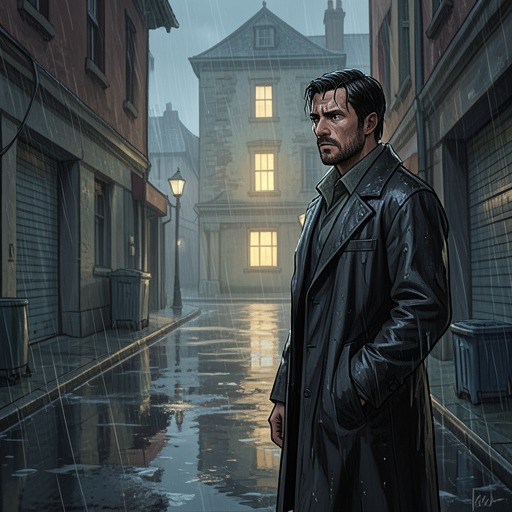
The contrast is stated most directly in Rebus’s recognition that he lives in what he regards as one of northern Europe’s most beautiful and civilized cities, yet must deal every day with its flipside. His unease comes from the coexistence of these realities, not from a rejection of the city’s beauty. The appearance of order and refinement remains present even as the work of policing brings him into contact with its less visible harms. The novel’s image of darkness therefore reaches beyond literal night: it describes the concealed pressures beneath the city’s reassuring self-image.
That distinction takes shape during Rebus’s late-night drive. He notices a teenager outside the Scottish Assembly building, apparently watching passing cars; elsewhere, young men stand near the Scottish Office, and several cars are gathered outside Calton Cemetery. After speaking with the boy, Rebus sees him walk away slowly and cross back over the road, apparently preoccupied. Rebus reads him as sad and lonely, but neither a hustler nor a victim. The encounter offers no confirmed explanation for the boy’s presence. Its significance lies instead in Rebus’s uncertainty: the city’s night contains people and activities he notices without fully understanding, and observation does not automatically become knowledge.
Calton Cemetery deepens that uncertainty through Rebus’s own memory. He had once taken his daughter inside to show her the graves of David Hume, the publisher Constable, the painter David Allan, and the statue of Abraham Lincoln. She had asked about men leaving the cemetery with bowed heads; Rebus remembered one older man and two teenagers, but had not pursued the question. On this later visit he cannot make himself enter. The contrast between the cemetery as a place of famous names and its unexplained visitors brings public heritage alongside private, unresolved unease. Rebus’s retreat does not establish what happens there; it marks the limits of what he has been willing or able to investigate.
Private shame and the conditions of secrecy
The darker face of the city also appears inside respectable social and professional life. While investigating James Carew’s apparent suicide, Rebus considers the possibility that Carew had been blackmailed. He notices that books with predominantly gay themes are separated from the more expensive titles on Carew’s shelves. Rebus interprets their placement as a sign that Carew may have been ashamed of his sexuality, and connects that secrecy to the possibility of blackmail. The novel locates vulnerability not outside respectable Edinburgh but within the private life of a successful estate agent.
Rebus’s reasoning is explicitly tied to the period’s social climate. He believes that the AIDS crisis had pushed homosexuality back into darker corners of society, leaving people who concealed the truth more exposed to pressure. In this reading, the polished public world does not merely conceal criminal conduct; its conventions can help create the conditions in which private lives become leverage. Carew’s circumstances remain part of Rebus’s investigation rather than a fully demonstrated explanation of his death, but the possibility broadens the novel’s account of darkness from street-level danger to shame and coercion within respectable circles.
Policing, power, and the official account
The investigation itself makes the divide between appearance and reality a matter of institutional trust. Rebus tells Superintendent Watson that the accusation against him is a setup. Watson nevertheless insists that the police must investigate it, even while accepting that the story appears foolish, and directs Rebus to leave the matter alone for a time. His response combines procedure with an assurance that the accusation can be dismantled. For Rebus, however, the charge means that the institution charged with uncovering hidden wrongdoing has also become a place where a false account must be formally entertained.
His exclusion does not end his concern with the investigation. When Malcolm Lanyon is held for questioning at Great London Road Police Station, Rebus is officially sidelined, and DS Dick and DC Cooper have been assigned the interrogation. Rebus stays close because he knows the questions and believes Lanyon may exploit a technicality to escape responsibility. The detail matters to the city’s wider portrait: investigative knowledge exists, but Rebus cannot exercise his usual authority, and the pursuit of an answer depends on procedures he does not control.
The final public version of events shows how much can disappear between scandal and report. The deaths of Finlay Andrews and Malcolm Lanyon are reported, and journalists pursue what they can learn. The account acknowledges that Andrews ran a club whose dealings were not strictly legitimate and that Lanyon died by suicide as authorities began closing in on his enterprise, but supplies no details of those activities. Carew’s suicide is declared unrelated to Lanyon’s, notwithstanding their friendship; Lanyon’s link to Andrews and the club remains uncertain in public, while his appointment as Carew’s executor is presented as a sad coincidence. The narration describes the scandal as small and soon forgotten, as shuttered rooms in elegant Georgian terraces become light again. The return of illumination does not amount to disclosure: the visible city recovers, while the relationships and activities behind the scandal remain obscure.
The contrast as a narrative structure
The image of Edinburgh’s polished surface and dark underside is built through repeated disparities between evidence and explanation. The boy outside the civic buildings is observed but not decoded; the cemetery holds public memorials and unexplained departures; Carew’s carefully separated books suggest a private vulnerability; and the investigation yields a public narrative that acknowledges wrongdoing while withholding its particulars. These episodes do not prove that every shadow conceals a crime. Instead, they keep attention on the difference between what is visible, what Rebus suspects, and what can be established or publicly said.
The contrast also gives the novel’s ending its restrained force. The city’s elegant buildings and ordinary social life continue, and Tracy finds work at a cafe and deli near the University Library. Rebus later sees Tracy, Brian Holmes, and Nell Stapleton sharing a joke over a meal, then leaves without ordering. That ordinary scene does not resolve the earlier scandal or reveal its full extent. It places everyday life beside unresolved knowledge, allowing Edinburgh’s brightness and its concealed history to persist at once. The city’s polished image is not simply exposed as false; rather, the novel shows how easily that image can resume after institutions and public accounts have left much of the darkness unnamed.